
 EN
EN
 ID
ID
Company Car Rental : Operating Lease vs. Purchasing a Fleet in Indonesia
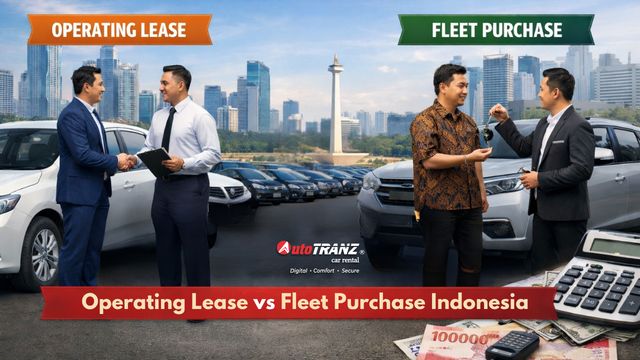
The spreadsheet looks clean until the CFO zooms into the fleet line. What seemed like a one-time capital expense suddenly stretches into five years of maintenance, tax, and replacement risk. In that Jakarta boardroom—somewhere between Sudirman and Kuningan—the GA manager (General Affairs) is asked a simple question: “Are we actually saving by owning these vehicles?” It's rarely a quick answer. Managing a fleet of company vehicles across SCBD traffic, Soekarno-Hatta routes, and Tangerang operations exposes cost layers most teams don't fully map at the start. That's where the decision between operating lease and fleet purchase becomes critical for any serious corporate car rental strategy.
🚗 Quick Answer
- An operating lease is usually better for Indonesian companies needing cost predictability.
- It reduces upfront capital and shifts maintenance risks to the vendor.
- Fleet purchase suits firms with specialized usage or internal fleet expertise.
- Most Jakarta corporates now prefer leasing due to flexibility and lower operational burden .
THE REAL COST DIFFERENCE MOST COMPANIES MISS
Before committing to a 3-year purchase cycle, most procurement teams underestimate how ownership costs compound over time. The purchase price is only the beginning. What follows is a continuous chain of obligations that quietly inflate the real cost of a company fleet.
Start with depresiasi (depreciation). A mid-range MPV in Indonesia typically loses around 15–20% of its value in the first year alone, based on industry observations. By year three, resale value can drop below 60% of the original price. That’s capital erosion, not just accounting.
Then come regulatory costs. Each vehicle requires active BPKB (vehicle ownership certificate), annual STNK (registration tax), and periodic KIR (roadworthiness inspection). These are mandatory, non-negotiable, and often handled manually by internal teams, adding administrative overhead.
Maintenance is another blind spot. Vehicles must be serviced at ATPM-certified workshops to maintain warranty validity. Even companies with internal mechanics still rely on external service networks for major repairs. Costs fluctuate. Downtime increases.
Now add human resources. Hiring pengemudi (drivers) means salaries, BPJS contributions, recruitment cycles, and replacements during leave periods. One absent driver can disrupt operations across departments.
Even companies with strong in-house maintenance teams face logistics issues when vehicles break down in Bekasi industrial zones like Cikarang or MM2100. Replacement vehicles must be arranged quickly. Insurance claims take time.
Individually, these costs seem manageable. Together, they create a financial profile far more complex than a simple purchase decision.
HOW TO CALCULATE TOTAL COST OF OWNERSHIP VS LEASE (PRACTICAL VIEW)
Before presenting a proposal to finance or directors, most GA and procurement teams need a clear comparison model. Not theoretical—practical, based on real operational inputs.
Start with ownership. List all direct and indirect costs over a typical three-to-five-year period:
- Vehicle purchase price (CAPEX)
- Annual depreciation impact
- STNK, KIR, and insurance renewal
- Maintenance and unexpected repairs
- Driver salary, BPJS, and replacement cost
- Downtime and replacement vehicle logistics
Now compare that with an operating lease structure. The calculation is simpler, but the implications are deeper:
- Fixed monthly payment (OPEX)
- Maintenance included
- Insurance included
- Driver option bundled
- Replacement vehicle guaranteed
At first glance, ownership may appear cheaper on paper. However, once variability is introduced—especially maintenance spikes or driver turnover—the total cost often exceeds initial projections.
Even small inefficiencies compound. One delayed repair. One idle vehicle. One missed compliance renewal. Over time, these add measurable cost leakage that doesn’t appear in initial budgeting.
For CFOs, the distinction is clear: ownership spreads uncertainty across multiple cost centers, while leasing consolidates it into one predictable expense line.
OPERATING LEASE IN INDONESIA: WHAT THE CONTRACT ACTUALLY COVERS
Operating lease, or sewa jangka panjang, shifts that complexity into a fixed, predictable structure. Instead of owning the asset, the company pays a monthly fee under a kontrak sewa (rental contract) that bundles most operational elements into one line item.
At its core, an operating lease includes vehicle usage without ownership. The company car Rental doesn’t carry asset depreciation on its balance sheet. That alone changes how CFOs evaluate cash flow and capital allocation.
Typically, the monthly rate covers maintenance, insurance, and regulatory compliance. Many contracts also include driver services, replacement vehicles, and 24/7 Emergency Road Assistance (ERA). That means fewer surprises. Less internal coordination.
Providers like AutoTRANZ structure long-term contracts so the monthly rate covers maintenance, insurance, and driver management — removing the procurement overhead from the GA team entirely. Since 2005, with 2,000+ vehicles and 50+ corporate partnerships, their model reflects what Jakarta corporates increasingly expect: reliability without operational friction. All vehicles carry active BPKB, STNK, KIR, and full insurance, backed by ERA 24/7 and AutoTRANZ Home Service (AHS) for on-site maintenance.
Even companies with existing fleets find value here. They reduce internal workload while maintaining operational continuity across Jakarta, Tangerang, and airport corridors.
Unlike a finance lease or vehicle credit, there is no ownership transfer at the end. That’s the point. The company pays for usage, not asset accumulation.
COMMON PROCUREMENT MISTAKES IN FLEET DECISIONS
Even experienced procurement teams make avoidable mistakes when evaluating fleet strategy. These are not strategic failures—they’re usually gaps in visibility.
Managing a growing armada kendaraan (fleet of vehicles) across Jakarta and Tangerang requires coordination across finance, HR, and operations. When one layer is overlooked, the decision becomes incomplete.
Here are the most common issues observed in Indonesian corporate environments:
- Focusing only on purchase price
Many teams compare lease vs buy using upfront cost only. This ignores lifecycle expenses, which often represent the majority of total cost. - Underestimating operational workload
Internal teams spend significant time managing vehicles—service scheduling, compliance tracking, driver coordination. This workload rarely appears in financial models. - Ignoring scalability needs
Business demand changes. A fixed fleet cannot easily adapt to expansion, project-based work, or seasonal spikes like Lebaran. - Overlooking regulatory impact
Policies like ganjil-genap and potential LVEZ implementation directly affect fleet usability. Owned fleets carry higher risk when regulations shift.
Conditional thinking helps here. If the business expects growth, geographic expansion, or operational variability, flexibility becomes more valuable than ownership.
FLEET PURCHASE: WHEN OWNING STILL MAKES SENSE
Ownership is not obsolete. It still fits specific operational models where control outweighs flexibility.
Companies with highly specialised vehicles—such as modified logistics units or production-linked equipment—often need full ownership to customise usage. Rental providers may not support such configurations.
In remote areas where vendor coverage is limited, owning ensures availability. Not every region outside Java has reliable rental infrastructure.
Strong internal fleet management capability also shifts the equation. If a company already operates a dedicated maintenance team, driver pool, and compliance system, the marginal cost of adding vehicles may be lower.
Vehicles tied directly to production processes, rather than mobility, are another case. These are assets, not transport tools. Ownership aligns with operational logic.
That said, even companies that own part of their fleet often supplement with corporate car rental during peak periods—especially around Lebaran or year-end demand spikes.
| Factor | Operating Lease (Company Car Rental) | Fleet Purchase (Buy Your Own Fleet) |
|---|---|---|
| Upfront Cost | Low or none | High capital expense |
| Monthly Cost Predictability | Fixed monthly rate | Variable, unpredictable |
| Maintenance Responsibility | Vendor handles all | Company handles all |
| Driver Management | Included option | Internal HR required |
| Vehicle Replacement | Provided by vendor | Self-managed |
| Tax Treatment (Indonesia) | Operational expenses | Capital assets |
| Flexibility to Scale | High, adjustable fleet size | Low, fixed assets |
| Best For | Growing companies | Specialized operations |
WHAT JAKARTA AND TANGERANG COMPANIES ARE CHOOSING IN 2026
Across South Jakarta’s corporate belt—Sudirman, Kuningan, and Gatot Subroto—the shift is visible. Procurement teams are moving away from ownership-heavy models toward flexible fleet strategies. The same pattern appears in BSD City, Alam Sutera, and Bintaro Jaya in Tangerang Selatan.
Part of this change is regulatory. The ganjil-genap traffic policy already complicates fleet utilisation. Emerging Low Vehicle Emission Zone (LVEZ) initiatives are expected to further pressure diesel-heavy fleets, making ownership riskier over time.
Managing a fleet of 30+ vehicles in Jakarta under these constraints is no longer just about cost. It’s about adaptability. Companies need the ability to adjust vehicle types, quantities, and usage patterns without long-term lock-in.
Industry data points to approximately 18% annual growth in corporate fleet outsourcing across Java. This isn’t driven by trend-following. It’s a response to operational realities—traffic regulation, urban expansion, and cost volatility.
In Bekasi’s industrial zones—Cikarang, MM2100, Delta Silicon—manufacturing firms are adopting hybrid models. Core vehicles may be owned, but operational fleets increasingly come from sewa mobil Jakarta providers.
Even conservative finance teams are re-evaluating. Fixed assets no longer guarantee efficiency.
For broader context on Indonesia’s transport and industrial trends, refer to Badan Pusat Statistik.
WHY LONG-TERM RENTAL FITS MODERN CORPORATE MOBILITY
As Jakarta’s business landscape evolves, mobility is no longer just about transport—it’s about efficiency, reliability, and adaptability.
Companies operating between SCBD, Kemayoran, and Soekarno-Hatta corridors face daily unpredictability. Traffic patterns shift. Regulations tighten. Workforce mobility needs expand.
Long-term rental models align with this environment because they remove rigidity. Instead of locking capital into depreciating assets, companies retain the ability to adjust.
Consider a typical scenario. A company expands operations from Kuningan to BSD City within 12 months. Under a purchase model, fleet allocation becomes a logistical challenge. Under a lease model, adjustments can be made within the contract structure.
Even companies using sewa mobil terbagus providers focus less on vehicle type and more on service continuity. Availability matters. Response time matters. Replacement assurance matters.
That’s where integrated services—vehicle, driver, maintenance, and emergency support—create operational stability without increasing internal complexity.
FINAL DECISION FRAMEWORK FOR INDONESIAN COMPANIES
Choosing between leasing and owning should not be based on trend or preference. It should follow a structured evaluation aligned with business priorities.
Use this simple decision lens:
- If your company prioritises cost predictability, leasing is the stronger option
- If your operations require custom-built or specialised vehicles, ownership may be necessary
- If your internal team lacks fleet management capacity, leasing reduces operational burden
- If your business expects growth or geographic expansion, flexibility becomes critical
Short-term thinking often favours ownership. Long-term operational clarity usually points toward leasing.
The companies making the most efficient decisions in 2026 are not the ones spending less upfront—they’re the ones managing variability better over time.
CLOSING
The decision between leasing and owning isn’t about preference—it’s about alignment with operational reality. Companies managing mobility across Jakarta, Tangerang, and Bekasi are prioritising flexibility, cost clarity, and reduced internal workload. For most, operating lease aligns better with how business moves today.
For companies currently weighing their options, AutoTRANZ's long-term rental team provides a no-obligation fleet consultation — request a fleet consultation.
FAQ
Q: What is the difference between an operating lease and vehicle credit for companies?
A: An operating lease does not provide vehicle ownership and includes operational services. Vehicle credit results in asset ownership with full responsibility for maintenance and additional costs.
Q: What is the typical monthly cost of corporate car rental in Jakarta?
A: The cost of corporate car rental in Jakarta typically ranges from Rp 6,000,000 to Rp 15,000,000 per unit per month, depending on the vehicle type, contract duration, and additional services such as a driver.
Q: Is long-term car rental more cost-effective than purchasing a fleet?
A: Long-term rental is often more cost-effective in total cost because it avoids depreciation, unexpected maintenance expenses, and complex operational management.
Q: Corporate car rental in Tangerang — what should be considered?
A: Choose a vendor with broad service coverage in BSD, Alam Sutera, and Bintaro, and ensure the contract includes maintenance, vehicle replacement, and emergency support.
Related article
-
How Corporate Car Rental Helps Companies Manage Transportation More Efficiently
Wednesday, 23 September 2026
-
Why One Premium Transportation Partner Is Better Than Five Ride-Hailing Bookings
Tuesday, 15 September 2026
-
Government & Embassy Car Rental in Jakarta: Choosing the Right Protocol Vehicles
Tuesday, 25 August 2026